
Natural stone & steps
Free-standing steps, retaining walls and natural-stone surfaces — founded so they last, and set so they are a pleasure to walk.
What is included
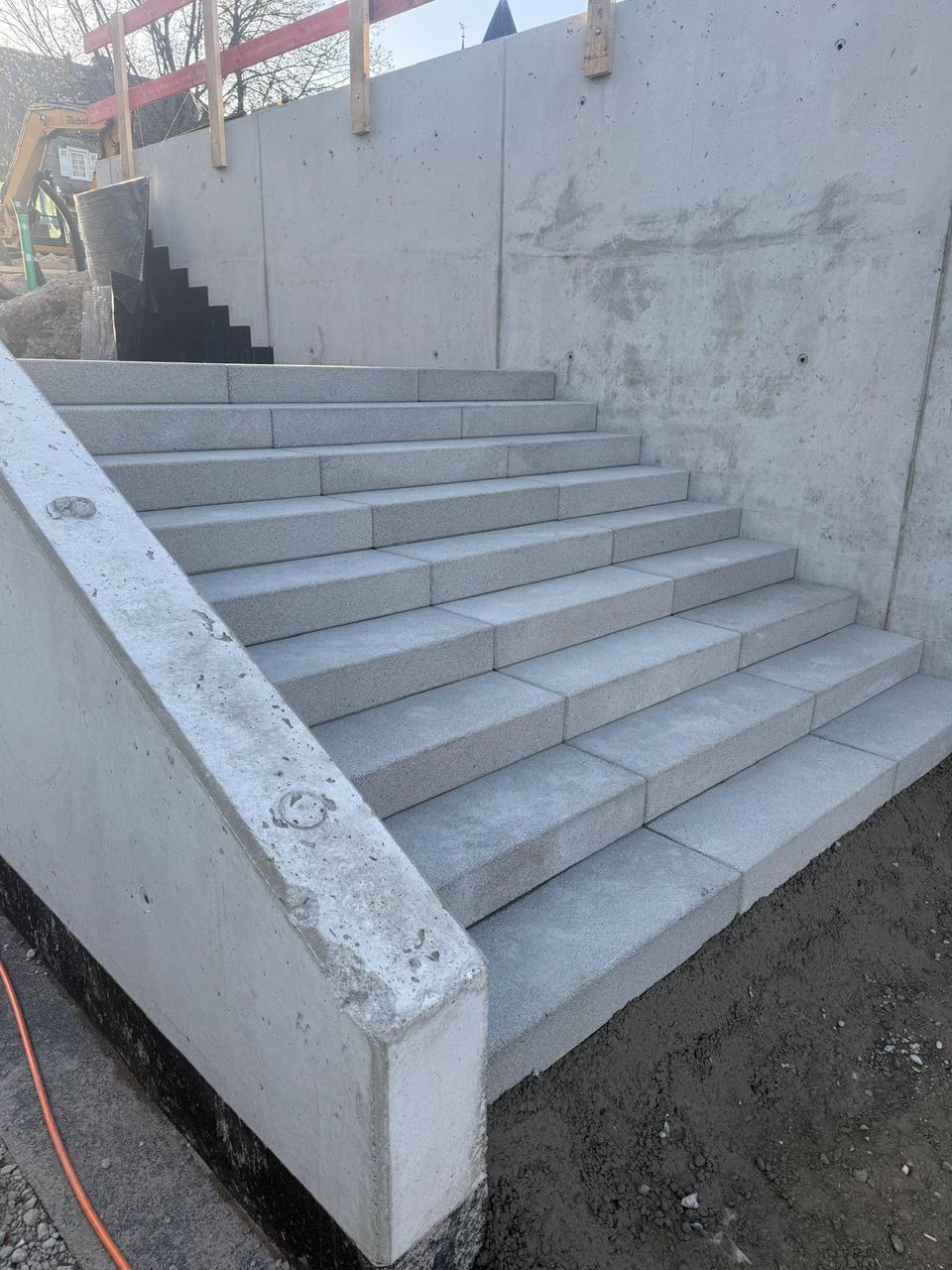
Solid granite or sandstone steps on frost-free foundations.
Slope retention with backfill and drainage behind the wall.
Large-format stone slabs on a bound or chipping bed.
Clean transitions to house, terrace and surrounding ground.
Step geometry decides whether a staircase feels right
Outdoor steps are built flatter than indoor stairs: roughly 14 to 16 centimetres rise with a 34 to 37 centimetre going. The check is the pace rule — twice the rise plus the going should come to about 63 centimetres. A staircase that misses it feels wrong on the way up without anyone being able to say why. So the number of steps is calculated from the height difference first, and only then is the overall length fixed.
What happens behind a wall is never visible
A retaining wall does not hold by its own weight alone but by what is built behind it: a permeable backfill and a drain that releases water pressure. Without them, water-saturated soil pushes against the wall after every long spell of rain, and eventually it no longer stands plumb. The foundation is taken below the frost line — in this region some 80 centimetres depth is the usual figure.
How it works
We listen, visit on site and measure precisely — the foundation for a perfectly fitting concept.
Detailed planning, material selection and a clear offer — including a transparent fixed price.
Our own team delivers every trade — coordinated, clean and on schedule. You sit back.
We hand over your finished space and, if you wish, maintain it long-term with our care service.
References for this service
Frequently asked questions
Granite or sandstone?
Granite is harder, absorbs almost no water and keeps its edges for decades — the more robust choice for steps used every day. Sandstone is warmer in tone and softer in effect, but more sensitive to de-icing salt and mechanical wear.
Does a retaining wall need approval?
That depends on height and location and is regulated locally in Hesse; low garden walls are usually exempt. At the survey we tell you whether your project falls into the range where you should check with the municipality.